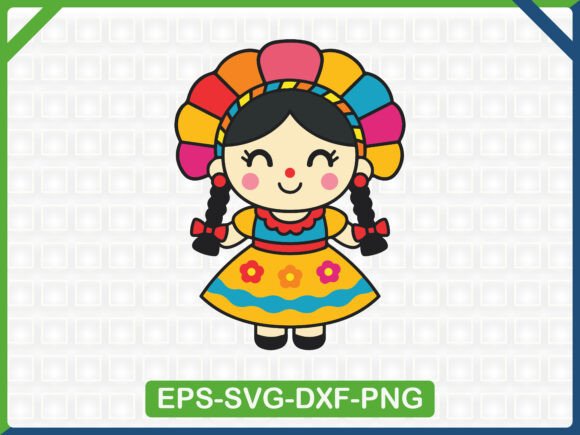
Mexican Folk Doll Embroidery SVG Design
First Impression: Festive, Handmade, and Instantly Recognizable
As an embroidery designer who’s set up at over 40 craft fairs—from Portland’s Renegade to Austin’s Eastside Market—I know what stops a shopper mid-aisle. The Mexican Folk Doll Embroidery SVG Design lands with warm, folk-art energy: bold outlines, expressive features, and a joyful, hand-crafted rhythm. It doesn’t read as minimalist or modern—it reads as festive, authentic, and uniquely handmade. That’s gold for booth traffic. Customers don’t pause for “clever” or “trendy”—they pause for feeling. This design delivers nostalgia, cultural warmth, and artisanal charm in one glance.
Where It Shines on Craft Fair Products
This isn’t just another T-Shirt Designs graphic—it’s a story carrier. On a heavyweight cotton tote bag? Perfect. The doll’s silhouette holds clarity even at 5.5”, and the balanced proportions make it legible from six feet away. On an apron? Ideal placement is centered above the pocket—large enough to read, small enough to leave room for functional details. For tea towel embroidery, scale it down to 3.75” and pair it with simple running-stitch borders: the contrast between folk detail and clean linen feels intentional, not busy.
As an embroidered patch? Yes—but only if digitized with thoughtful stitch density. Avoid cramming tiny facial features into a 2” circle; simplify eyes or stylize hair into bold satin-stitch shapes. On curved surfaces like caps, test the design at 3.25” height—anything taller risks distortion near the crown seam. For pillow covers and fabric pouches, go bold: 6–7” works beautifully, especially when framed with a subtle zigzag or cross-stitch border that echoes traditional Mexican textile motifs.
What Makes It Sell—And What Requires Caution
The Mexican Folk Doll Embroidery SVG Design succeeds because it’s scalable, emotionally resonant, and booth-ready. At craft fairs, buyers scan quickly—they’re drawn to color, contrast, and clear intent. This design delivers both. It photographs exceptionally well for Etsy listings and printable mockups: bright thread colors pop against natural canvas, oatmeal linen, or terracotta-dyed cotton. Its visual weight gives handmade products instant perceived value—even before customers touch the fabric.
But here’s where experience matters: dense stitch areas (like layered skirts or braided hair) can cause puckering on lightweight or textured towels. Tiny details—say, individual flower petals or fine line work—lose definition on dark fabric or tightly woven hemp. And on curved cap surfaces, tight satin-stitch curves may shift or skip without proper stabilizer and tension calibration.
Production Notes Every Embroidery Designer Should Check
- Test first on scrap fabric—especially if using textured weaves or blends. A tea towel’s loop pile eats fine detail fast.
- Review thread contrast: vibrant reds and cobalt blues sing on cream or beige, but mute on charcoal or navy unless you add underlay or switch to metallic or high-sheen rayon.
- Confirm hoop size compatibility: if your machine uses 4×4 hoops, avoid stretching this design beyond 3.8”. Larger versions need 5×7 or bigger—and that changes your production flow.
- Inspect stitch density before batching. Over 12,000 stitches in a 4” area? Add a tear-away + cut-away stabilizer combo, especially for commercial embroidery on apparel.
- Create at least one real mockup—not just a digital preview. Drape it on your actual tote bag fabric, hold it in fair lighting, and walk 10 feet back. Does it still read as friendly and distinct?
- Compare fabric colors side-by-side: what looks cheerful on screen can read muddy on oatmeal linen if thread values aren’t adjusted.
- Confirm commercial licensing before selling finished products. Since the listing mentions “prints, t-shirt designs, mug making, posters, and many other tasks,” verify scope—especially for resale of physical embroidered goods.
Booth Impact & Buyer Engagement
In a sea of neutral linens and minimalist lettering, the Mexican Folk Doll Embroidery SVG Design creates instant booth personality. I’ve watched customers point, smile, and say, “That’s my abuela’s village!”—that emotional hook drives impulse buys and repeat visits. It strengthens brand consistency for small shop owners who curate around heritage, celebration, or handmade joy. On market bags and embroidered patches, it becomes a conversation starter—not just decoration.
For Etsy sellers, it elevates listings: paired with lifestyle photos (a sunlit kitchen with embroidered tea towels, a gift-wrapped pouch beside dried lavender), it tells a cohesive story. As a digital embroidery file, it’s versatile—but its true strength is in finished product execution. When stitched cleanly on quality fabric, it signals care, skill, and cultural respect—not just a downloaded graphic.
Final Thought: A Design That Sells Because It Feels Human
The Mexican Folk Doll Embroidery SVG Design isn’t about perfection—it’s about presence. It works because it honors tradition while fitting seamlessly into today’s handmade marketplace. It’s festive without being kitschy, detailed without being fussy, and scalable without losing soul. For craft fair sellers, embroidery business owners, and creative entrepreneurs building a small shop product line, this is the kind of design that earns compliments, sparks stories, and moves off the table before noon. Just remember: let the folk art breathe. Simplify where needed, stabilize where required, and always—always—test before you batch.